I stumbled on a very interesting YouTube video: How to Read so that you *Retain* Information by Jeffrey Kaplan, where he talks about marginalia.
What the hell are marginalia though?
There’s actually something interesting not so much in what they are, but rather in where the name comes from.
They are, in fact, just scribbles — well, hand-written notes — at the margins of a page.
It’s trivial to understand that the word marginalia comes from margin. But why did margin come to be marginalia and not just something like margin scribbles?
I think the mechanism is quite curious: ancient Romans could recast a name like margo, marginis — which obviously translates to margin — into an adjective by appending the suffix -alis — which means related to.
By the way, in Latin nouns are identified by the nominative and the genitive, while adjectives are identified by the masculine, feminine and neuter nominative. So we have
- from natio (nation), nationis (of the nation), nationalis, nationalis, nationale (national), and
- from margo (margin), marginis (of the margin), marginalis, marginalis, marginale (marginal).
Yeah. That’s not curious at all. That’s just how it works.
The nice stuff is yet to come.
Ancient Romans could turn adjectives back to nouns. So things that have a certain property could be referred to with just one word. So, instead of saying the whole phrase things that sit at the margin, they just used one single word.
That word was the neuter plural nominative which was made by adding the desinence -ia to the root marginal-.
So, today we have:
- memorabilia — things to be remembered — or remains,
- or the Italian mirabilia — things that are worth seeing — or wonders,
- and, of course, marginalia — fluff that is scribbled at the margin of a page.
Amazing.
What about marginalia again?
Oh, right!
Jeffrey Kaplan, with his captivating gestures, says that if you use notes at the margins of the page in a certain way, comprehension and retention are highly improved.
That certain way is wonderfully shown in a scribble:
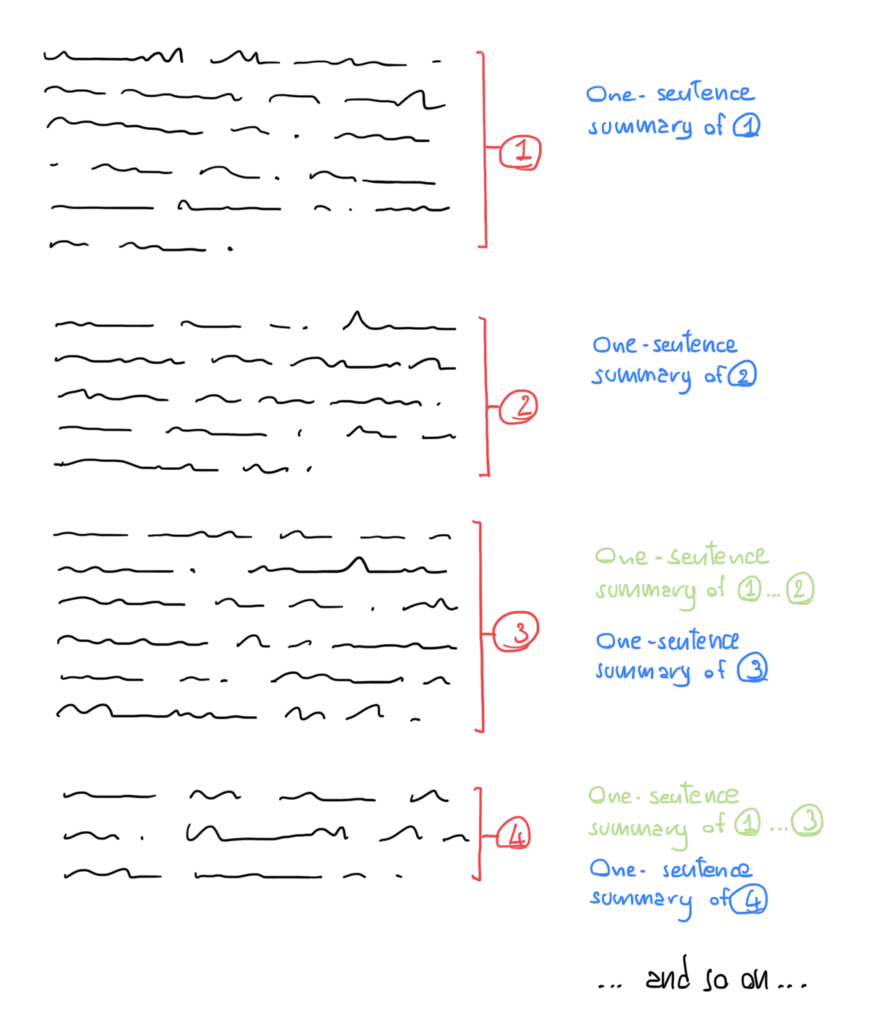
So, you start summarizing the first paragraph with one single sentence, and again the second paragraph with another single sentence.
Then, from the third paragraph on, you summarize what’s in all the paragraphs before the last one with just one sentence, and add another sentence for only the last paragraph.
It’s clear that, by doing things this way, there’s a fair amount of abstraction, a nice effort in synthesis, and a lot of repetition. And — as everyone knows — repetition is the key.
What is a paragraph even?
Well, if you have doubts about how to identify a paragraph, you’re not alone — I had those too.
I guess a rule of thumb is always valid.
When an author writes things down, he’ll have things to say that are strictly connected. Maybe he will use a couple of longer sentences, or maybe twelve — or so — shorter sentences.
But, at some point, he’ll have to introduce a new concept and set it apart from the previous one — though in the same chapter.
So there will probably be some lines that are a bit more spaced apart than the other ones. Well, that’s the limit of a paragraph.
Does it work?
I don’t know.
I always hated margin notes: they were of little use to me, because I found mine too short or too generic, and I like longer summaries and schemes better. But I am captivated by this variation. So, I’m certainly gonna try.